


Prime Minister Keir Starmer announced his resignation on the morning of 22 June 2026, making him the UK’s sixth prime minister to leave office in under a decade. For traders and investors, the key question is not just who comes next, but what the transition means for sterling, UK government bonds, and equity markets.
Published on 22/06/2026
Prime Minister Keir Starmer announced his resignation on the morning of 22 June 2026, making him the UK’s sixth prime minister to leave office in under a decade. For traders and investors, the key question is not just who comes next, but what the transition means for sterling, UK government bonds, and equity markets.
Published on 22/06/2026
What Happened
Starmer stepped down after sustained pressure from within his own Labour Party, with a new leader expected to be in place before parliament returns in September. Andy Burnham, the former Mayor of Greater Manchester, won the Makerfield by-election last week and is widely seen as the frontrunner to succeed him.
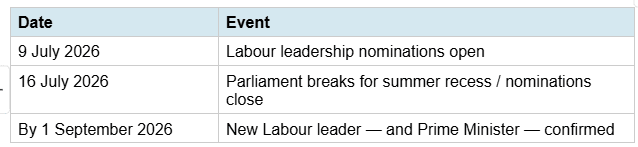
The timetable is as follows: Labour leadership nominations open on 9 July and close when Parliament breaks for summer recess on 16 July. If no challenger emerges, a successor could be confirmed shortly after. A contested race would conclude by 1 September.
Starmer’s exit adds to a remarkable period of political churn. David Cameron resigned after losing the 2016 Brexit referendum. Theresa May departed after three years of failed negotiations. Boris Johnson was forced out in July 2022. Liz Truss lasted 44 days. Rishi Sunak called an early election and lost. Britain is now heading for its seventh leader in a decade.
How Markets Reacted
The initial reaction was measured rather than dramatic. Markets had largely priced in the change ahead of today’s announcement.
Sterling remained lower on the day, trading at around $1.319 and 86.76 pence per euro. The 10-year gilt yield was a touch higher at 4.85%, while the FTSE 100 was marginally lower. Crucially, the pound had already lost around 3% since February as Starmer’s leadership came under increasing threat, meaning today’s move reflected confirmation, not surprise.
As one analyst noted, markets were watching gilts more than the pound and gilt markets looked quiet. The focus has shifted quickly to what the next leader will do, not the resignation itself.
Gilts: The Market That Matters Most
UK government bonds — gilts are the sharpest indicator of how institutional investors view domestic political and fiscal risk. When confidence in the government’s fiscal discipline weakens, gilt prices fall and yields rise, increasing the UK’s borrowing costs.
Earlier in May, as pressure on Starmer intensified, yields on the benchmark 10-year gilt jumped 10 basis points to around 5.1%, with long-end gilt yields touching their highest levels since 1998. Political uncertainty in the UK typically hits bond markets first and hardest.
The central question now is whether the next Labour leader will maintain Chancellor Reeves’s fiscal rules. A candidate signalling higher public spending could push yields higher still. A more centrist outcome, one that credibly commits to the existing framework could stabilise the gilt market.
UK gilt and bond CFDs can be traded on XTB’s platform alongside major indices.
The Burnham Variable
Markets have not panicked at Starmer’s exit, but they are watching his likely successor carefully. Analysts note that markets are wary of Burnham’s previous policy positions and would prefer to see his governing ideas fleshed out via a leadership contest, keeping policy surprises to a minimum. Difficult decisions around welfare and defence spending are already in the queue, each with the potential to move gilts and wider UK markets.
For now, the fact that Burnham has been assembling an economic team and has distanced himself from earlier statements about fiscal policy has offered some reassurance. But uncertainty remains elevated until a full policy platform emerges.
What Traders and Investors Should Watch
GBP/USD — Holding around $1.319, down ~3% since February. Watch for further weakness if the leadership contest signals a fiscally expansive agenda. Trade GBP pairs via XTB’s forex platform.
Political events can lead to sharp moves in currencies, bonds and indices. Traders using CFDs should understand what leverage is, as both profits and losses can be magnified during periods of heightened market volatility.
UK Gilts (10-year) — Yield at ~4.85%. Markets are sensitive to any departure from Reeves’s fiscal framework. Available to trade as bond CFDs.
FTSE 100 vs FTSE 250 — The FTSE 100, with its heavy international earnings base, has largely shrugged off domestic political noise. The FTSE 250, with more domestic exposure, is more vulnerable to higher borrowing costs and slower UK growth.
Leadership outcome — A coronation for Burnham would deliver clarity quickly. A contested race running to September keeps uncertainty elevated.
Bank of England — A falling pound keeps inflation stickier and makes rate cuts less likely. Watch BoE commentary for any shift in tone in response to the political backdrop.
Key Dates
The Bigger Picture
Starmer’s resignation comes almost ten years to the day since the UK voted to leave the European Union. His successor will be Britain’s seventh leader in that period — underscoring how political and economic turmoil continue to unsettle UK markets long after the Brexit process concluded. Investing in UK assets continues to carry a risk premium given the bouts of political instability seen over the past decade, and there is little sign of that easing in the near term.
Political events can lead to sharp moves in currencies, bonds and indices. Investors considering CFD trading should understand what leverage is, as both profits and losses can be magnified during periods of heightened market volatility.
CFDs are complex instruments and come with a high risk of losing money rapidly due to leverage. 72% of retail investor accounts lose money when trading CFDs with this provider. You should consider whether you understand how CFDs work and whether you can afford to take the high risk of losing your money.

EURUSD Trading - How to invest in the EURUSD currency pair?

Could Bond Markets Decide Britain's Next Prime Minister?

Heatwave Market Dynamics
This content has been created by XTB S.A. This service is provided by XTB S.A., with its registered office in Warsaw, at Prosta 67, 00-838 Warsaw, Poland, entered in the register of entrepreneurs of the National Court Register (Krajowy Rejestr Sądowy) conducted by District Court for the Capital City of Warsaw, XII Commercial Division of the National Court Register under KRS number 0000217580, REGON number 015803782 and Tax Identification Number (NIP) 527-24-43-955, with the fully paid up share capital in the amount of PLN 5.869.181,75. XTB S.A. conducts brokerage activities on the basis of the license granted by Polish Securities and Exchange Commission on 8th November 2005 No. DDM-M-4021-57-1/2005 and is supervised by Polish Supervision Authority.